
Animal Use & Occupational Safety
The University of Michigan is committed to the health and safety of our research personnel and to the animals entrusted to our care. Although minimal, there are some hazards associated with working around, and with, animals in a research environment. A brief summary of these hazards is outlined below, including information and resources to help mitigate risk(s).
 Links marked with a lock icon can only be accessed using valid U-M login credentials.
Animal Handler Medical Surveillance Program
The University’s Institutional Animal Care & Use Committee (IACUC), in partnership with the U-M Department of Environment, Health & Safety (EHS), works to provide proper assessment and management of the risks associated with the animals and materials used in research through its Animal Handler Medical Surveillance Program.
All personnel MUST be enrolled in the Animal Handler Medical Surveillance Program (Medical Surveillance Program) if they have contact with:
- Animals
- Non-fixed or non-sterilized animal tissues, fluids, or waste
- Non-sanitized animal caging or enclosures
- Animal equipment, devices, or facilities to conduct repairs/maintenance, and/or
- Are affiliated with an animal use protocol
Personnel meeting one or more of these criteria will be enrolled in the Medical Surveillance Program via the following:
- If an individual is part of the eRAM system, enrollment will occur automatically based on protocol affiliation
- If an individual is NOT in the eRAM system, they should contact EHS at [email protected] to complete enrollment
The Enterprise Health Portal is used to communicate about occupational health and safety-related requirements, completion of the Animal Handler Medical Surveillance Questionnaire, and to schedule appointments with the Occupational Health Services Clinic.
Visit the U-M’s Human Resources website for more information about Enterprise Health.
Occupational Health & Safety Topics
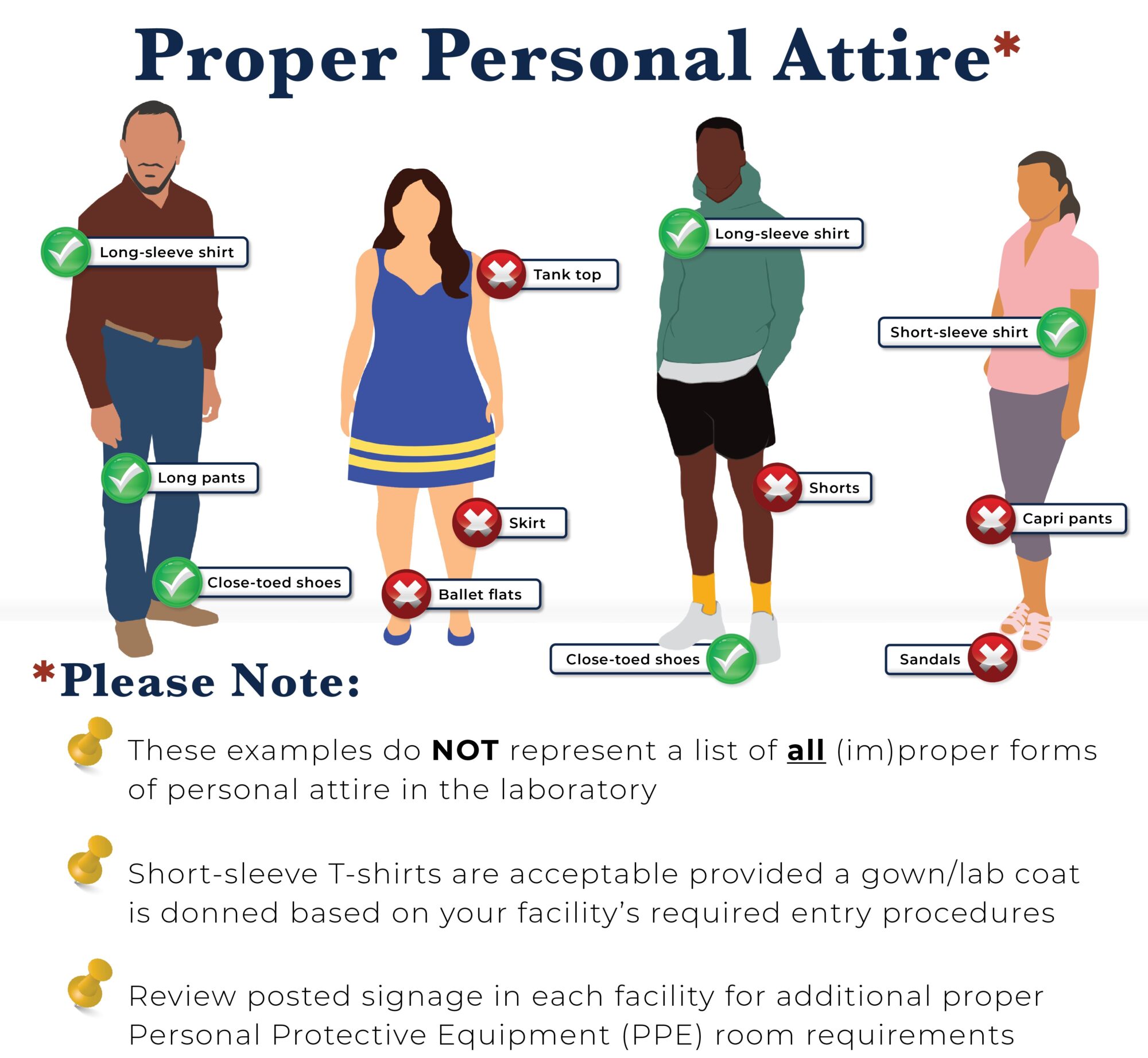
Proper personal attire (click to expand image at right) worn in the laboratory and/or animal care facility MUST provide full coverage of the legs, feet, and torso REGARDLESS of outdoor weather conditions.
Requirements for Proper Personal Attire
- Shirts or tops must cover the upper torso. Short-sleeve T-shirts are acceptable AS LONG AS a gown or laboratory coat is also donned based on your facility’s entry procedures.
- Note: laboratory coats should NOT be worn in animal housing rooms.
- Shorts, skirts, or pants/capris that leave any part of the leg exposed are NOT permitted.
- Shoes must completely cover the feet. Shoes with holes (including sandals, ballet flats, open toe, open weave) are NOT allowed.
Additional Resources
- Download the U-M Chemical Hygiene Plan for a complete list of proper laboratory attire.
- Visit the EHS website or download the EHS Animal Handler PPE Chartfor minimum Personal Protective Equipment (PPE) requirements when working with specific animal species and performing certain work-related tasks.
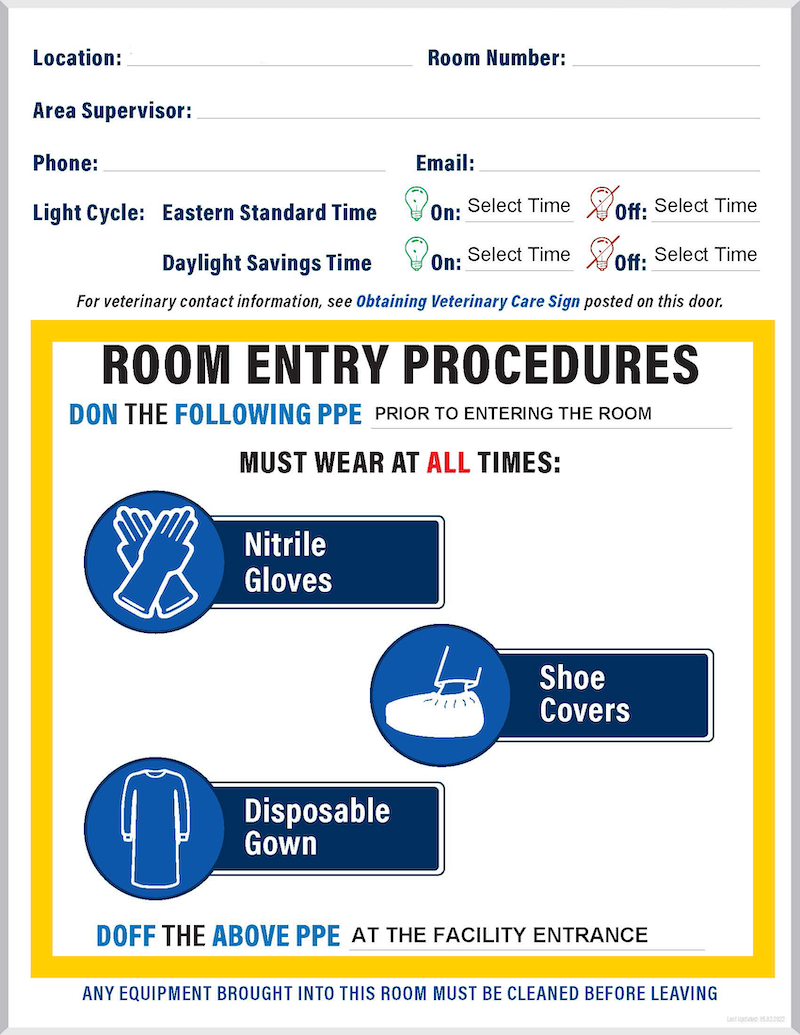
- Refer to all posted signage (see sample room entry sign
 ) for specific room entry instructions and appropriate donning/doffing procedures for required PPE.
Although allergies may only affect a small percentage of individuals, allergic reactions (including respiratory and skin disorders; eye, nose, and throat irritation; and skin hives) are among the most common and most important of the occupational hazards associated with the care and use of laboratory animals.
Symptoms typically develop within the first year after a person begins working with animals, but may appear several years later.
Procedures, such as those outlined below, should be routinely followed in order to prevent the development of an animal allergy:
- Animals should be housed, as well as manipulated and/or handled, in extremely well-ventilated areas
- Gloves and protective clothing should always be worn to prevent direct exposure to animals, animal urine, and animal dander (small particles of animal hair, feathers, or skin)
- Cages should be changed frequently and surgical masks should be worn during the changing of cages to prevent the inhalation of contaminated material
For more information, please visit the EHS Research & Clinical Safety: Animals website.
EHS reviews all protocols involving hazardous materials to ensure that the appropriate control measures are in place before the IACUC will approve the use of hazardous materials in any research, testing, or teaching activities involving animals.
Depending on the type(s) of hazardous materials used, additional approvals by University oversight committees (e.g., Radiation Policy Committee, Institutional Biosafety Committee) may also be necessary before the IACUC grants approval.
Any activities included in an IACUC approved protocol that involve the use of hazardous materials MUST be conducted in accordance with:
- EHS-defined engineering control practices,
- Use of the appropriate Personal Protective Equipment (PPE), and
- All applicable safety policies and standards of practice (SOPs).
Additional safety training is also required for personnel working with hazardous materials. Training requirements are determined on a case-by-case basis depending on the individual’s animal handling details as outlined in the protocol, the type of animal, and the type of chemical and/or hazard(s) that may be encountered throughout the course of the research project.
Visit the Training page for details on how animal care and use training is assigned.
EHS Safety Findings
EHS determinations (i.e., “Safety Findings”) are shared with ANY individual who is assigned the Animal Handler role on a protocol AFTER all findings have been accepted by the PI or PI Proxy. Findings are sent through an automated eRAM email notification and are also made available under the EHS Safety Findings tab in the eRAM Protocol Workspace.
Findings often include, but are NOT limited to, specific requirements for:
- Proper personal protective equipment (PPE)
- Additional safety training
- Animal housing level and duration (see the Animal Husbandry & Housing page for more information about U-M’s containment housing facilities)
- Engineering controls used in materials preparation and/or administration
- Appropriate waste disposal (e.g., materials containing products, carcasses, bedding)
For more information, review this article on EHS Safety Findings.
Zoonotic diseases are diseases that can be transmitted between animals and humans. Although the risk of acquiring infections from laboratory animals is low, many zoonotic diseases can be serious.
In order to minimize the risk of contracting a zoonotic disease, it is critical that you:
- Follow ALL posted safety procedures,
- Wear any prescribed Personal Protective Equipment (PPE), and
- Report any exposure incidents EVEN IF medical attention is not sought.
For additional information, including proper prevention techniques and what to do in case of an animal bite or scratch, please review EHS’s Animal Safety – Physical Hazards page.
Individuals who have sustained an animal bite or scratch should seek the appropriate medical attention to avoid any potential complications.
For a more thorough discussion of the hazards found in animal care facilities, as well as the appropriate safety precautions and methods of control, please review the EHS Animal Safety website.
Report Safety &
Environmental Concerns
Monday – Friday
7:30 AM – 4:30 PM
Contact EHS at (734) 647-1143
Report Safety & Environmental Concerns After Hours
Emergency contact available through DPSS at
(734) 763-1131
Occupational Safety in Animal Care Facilities Brochure
Download the PDF brochure to learn about occupational health and safety in animal care facilities.
Related A-Z Documents
Questions?
Questions or concerns about animal use and occupational health and safety should be directed to EHS at [email protected] or (734) 647-1143.
Concerns regarding the use of hazardous materials in animal activities should be reported to the Animal Care & Use Office, EHS, the U-M’s Institutional Official, or through either the Animal Concern Hotline or the Compliance Hotline at (866) 990-0111.