
Animal Care & Use FAQs
Below you will find a list of frequently asked questions about U-M’s Animal Care & Use Program sorted into four key sections – General Topics, Oversight, Operations, and Specific Issues Pertaining to Animal Research. As a public institution and an accredited site for animal use, we are open to inquiries, reports of concern, or other communications from within and beyond the university community.
If you are a researcher interested in learning about the many resources available to support your project, we encourage you to review the following:
- Protocol Approval – Learn about the protocol approval process, including new PI onboarding, protocol review, waiver requests from standard IACUC review, and protocol renewals.
- Facilities & Systems Access – Information on how to gain access to the myriad systems U-M uses to manage animal care and use projects.
- Training – Learn about U-M’s multi-faceted animal care and use training program, which includes personnel training, continuing education, and more.
- Research Support Services – Explore the many aspects of managing an animal care and use project, including fee-for-service research support services and budget consultation to assist with your next research grant proposal.
- Animal Use – Information about the standard animal care and use services offered by the U-M, including animal transport, animal use and occupational safety, animal husbandry, veterinary care consultations, and animal enrichment.
If you are a member of the media, or have a media inquiry, please email [email protected] or call the Michigan Medicine Department of Communication at (734) 764-2220 and your question will be routed to the appropriate media team member.
General Topics
As a public research university, we are committed to the pursuit of scientific advancements that improve the health and well-being of human and animal patients alike.
Joint replacement procedures, organ transplants, the treatment of numerous diseases, and countless drug therapies would not be possible without the critical contributions of animals in research and instruction. Many of these medical breakthroughs, including vaccines, surgical interventions, and the management of chronic conditions such as arthritis and heart disease, have also benefited companion animals as well as animals in the wild.
Before methods to prevent, treat, and cure any number of illnesses can be developed, scientists must first understand how complex biological systems function. Once a discovery has been made, federal law requires extensive safety and efficacy testing using both animal and non-animal models prior to the start of human clinical trials.
Please review our complete Position Statement on Animal Research posted on U-M’s Key Issues website for more information.
The University is firmly committed to the “Three Rs” principle of biomedical research:
- Reduce the number of animals used to the minimum required for the study,
- Replace animals with less sentient or non-animal models whenever possible; and
- Refine all practices to provide the best animal welfare possible.
As an ethical and legal imperative, any proposed use of animals in research or instruction must include a detailed justification outlining:
- Why the proposed species/model is the most scientifically valid method of study;
- What consideration has been given to relevant new approach methodologies (NAMs) such as computer-based modeling, organoids, and/or Artificial Intelligence; and
- What steps have been taken to address the Three 3Rs.
In recent years, we have implemented simulators to reduce the use of animals in training clinical staff; increased the use of cell cultures to test new treatments; and established mechanisms such as the Quality Improvement Fund and the Refinement & Enrichment Advancements Laboratory to advance Three Rs initiatives at the university and across the broader field of laboratory animal medicine.
Mice, rats, and various species of fish comprise 98 percent of all animals involved in scientific research at U-M. The other 2 percent includes frogs, pigs, rabbits, primates, sheep, and other rodent species.
Most research protocols require animals to be humanely euthanized at the conclusion of a study so that scientists can examine their internal organs and tissues to evaluate important changes at the cellular/microscopic level. Strict guidelines based on the American Veterinary Medical Association’s Guidelines for the Euthanasia of Animals (2020 Edition) are followed for each species to help ensure that animals experience no pain, discomfort, or distress.
- General media inquiries and requests with non-urgent deadlines may be sent to [email protected].
- For immediate assistance with urgent matters, please call the Michigan Medicine Department of Communication at (734) 764-2220 and your question will be routed to the appropriate media team member.
Our complete Position Statement on Animal Research is also available on U-M’s Key Issues website.
If you are interested in having a member of our Animal Care & Use Team come and speak to your students or group members about animal care and use at the University of Michigan, please contact the Animal Care & Use Office at [email protected] or (734) 763-8028 with information about the time, location, audience, and general theme/topic for your discussion.
Oversight
Federal law requires that the institution establish an autonomous entity (i.e., the Institutional Animal Care & Use Committee) to oversee its animal care and use program. At minimum, this Committee must include:
- A Doctor of Veterinary Medicine with training and experience in laboratory animal science and medicine
- At least one practicing scientist with research experience involving animals
- At least one member from a non-scientific background, drawn from inside or outside the institution
- At least one public member to represent general community interests in the proper care and use of animals
In addition to reviewing, approving, and monitoring all projects involving animals, the IACUC is also responsible for ensuring that the U-M operates in accordance with all applicable laws, regulations, and standards governing the humane care and use of animals in research and instruction.
The university is subject to routine announced and unannounced inspections to assure animal welfare and compliance. Additionally, the U-M has been continuously accredited by AAALAC, International, a private, non-profit organization that promotes the humane treatment of animals in science through voluntary program assessments and subsequent accreditation, since its first Site Visit in 1971.
AAALAC re-accreditation occurs every three years and demonstrates that the university is committed to meeting and exceeding the highest national and professional standards of excellence in animal care and use.
Before a U-M scientist can begin a study involving animals, a detailed description of the proposed project (e.g., an animal use protocol) must be approved by the Institutional Animal Care & Use Committee (IACUC).
The IACUC reviews the scientific goals, objectives, and procedures of the proposed research to ensure that:
- The project will benefit human or animal health
- The use of animals and select(ed) species have been appropriately justified
- The research complies with all applicable laws, regulations, and guidelines
- Humane use guidelines are followed
- Proper practices are in place to reduce animal pain and distress
- Personnel receive requisite training
The review process is rigorous and often takes many weeks to complete. The IACUC routinely monitors research it has approved to make sure that researchers and all affiliated personnel are following the letter and spirit of their protocol.
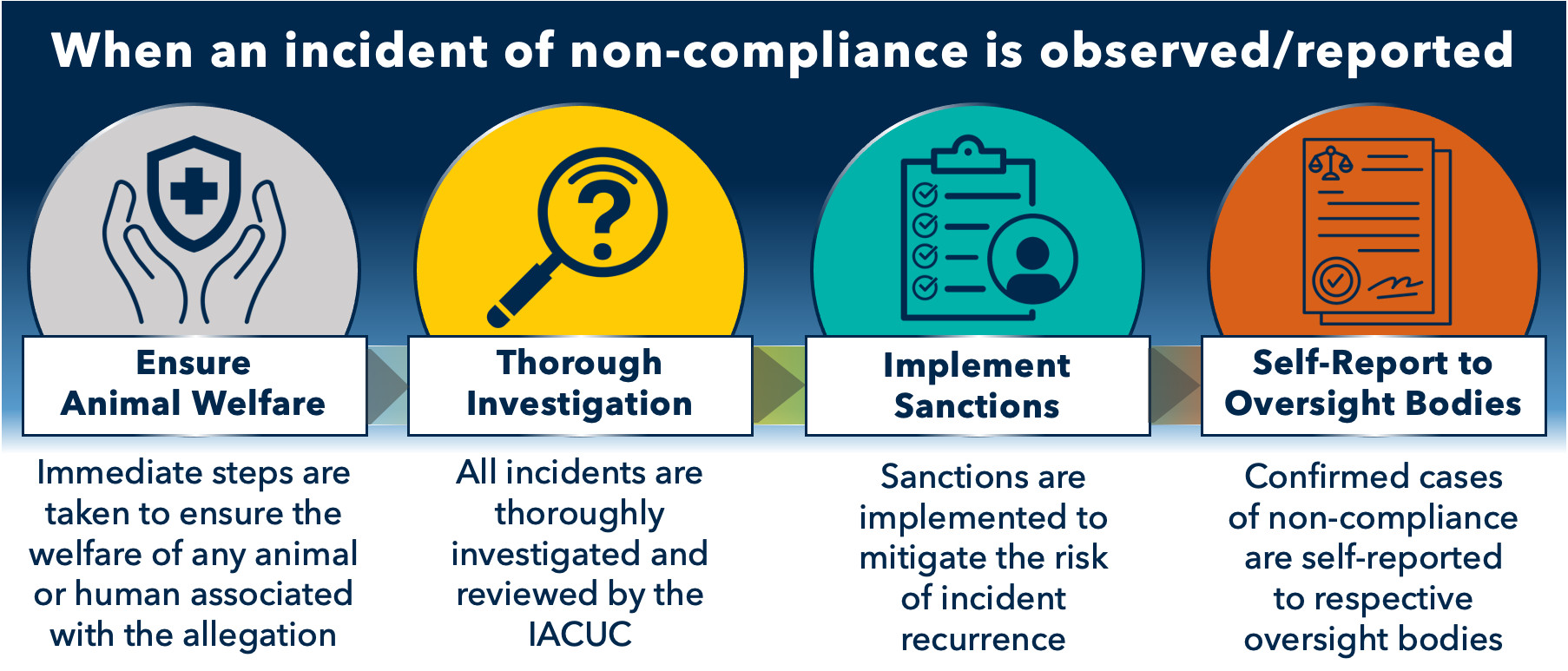
The Animal Care & Use Program has myriad policies, controls, and procedures in place to safeguard animal welfare and mitigate incidents of non-compliance. When an incident of non-compliance is observed or reported:*
- Immediate steps are taken to ensure the welfare of any animal or human associated with the allegation.
- All allegations/incidents are thoroughly investigated and reviewed by the Institutional Animal Care & Use Committee in accordance with the procedures outlined by the Policy on Investigating Noncompliance and Animal Welfare Concerns.
- Corrective action plans – including possible sanctions – are implemented to mitigate the risk of incident recurrence.
- Consistent with federal regulatory expectations that govern laboratory animal care and use, all confirmed cases of non-compliance are self-reported to the institution’s respective oversight bodies. These agencies conduct a secondary, independent assessment of each incident – including the university’s response and corrective action plan(s) – to assure that all necessary steps have been taken to protect animal welfare and maintain regulatory compliance.
Additional information on how the U-M addresses allegations of research misconduct that do NOT directly relate to the care and use of animals can be found on the Key Issues page.
*Anonymous reports are acceptable, and all are investigated. The identity of anyone making an anonymous report will be held in strict confidence. Federal laws prohibit discrimination or reprisal for reporting violations of standards and regulations promulgated under the Animal Welfare Act.
You can call the Animal Concern Hotline at (734) 763-8028 or report any concerns anonymously using our online submission form.
Reports and sources of information are maintained in confidence within University guidelines and in accordance with standards and regulations promulgated under the Animal Welfare Act.
Operations
All animals are purchased from specialized vendors who breed the animals specifically for use in research. Vendors of certain species must also be licensed by the United States Department of Agriculture.
The Unit for Laboratory Animal Medicine (ULAM) is responsible for the veterinary care of all animals on campus. Licensed veterinarians and veterinary technicians with specialized training in laboratory animal medicine conduct daily observations of all animals housed in U-M facilities to ensure animal welfare and the timely diagnosis/treatment of any observed medical conditions. Animals are housed in carefully controlled research facilities where trained technicians provide expert, around-the-clock husbandry care.
All personnel who work with animals must complete training on the proper care and use of animals PRIOR TO beginning their work and at regular intervals to stay apprised of important advancements in laboratory animal medicine.
Any member of the faculty, staff, student body, or public having reason to question the treatment of animals at U-M should report suspected cases of animal abuse, misuse, or mistreatment via the Animal Concern Hotline.
The U-M research community understands that we have an ethical, legal, and scientific imperative to safeguard animal health and well-being, including the prevention and alleviation of pain and distress. If a procedure is painful for a human, it is considered painful for the animal(s).
Accordingly:
- Researchers must provide justification for any procedure that may cause more than momentary pain or distress and certify that all appropriate alternatives have been considered.
- Detailed descriptions outlining intervention methods (e.g., anesthetics, analgesics, other therapeutic agents) used to minimize pain, distress, and/or injury must be provided and assessed as part of the extensive protocol review process.
- U-M practices align with nationally-recognized standards set forth by the American Veterinary Medical Association, the American College of Laboratory Animal Medicine, and numerous federal laws, which mandate that appropriate anesthetics/analgesics be used for any potentially painful procedure.
The overwhelming majority of animals used in biomedical research are “purpose bred” by licensed vendors who routinely screen for pathogens of concern. All animals shipped to/from campus undergo an extensive health evaluation and, where necessary, appropriate quarantine measures and/or treatment(s) for any viral, bacterial, or parasitic infections.
U-M facilities are subject to strict institutional and regulatory oversight from multiple departments and agencies who routinely assess the nature of the work being performed to ensure that all appropriate safeguards – training, engineering controls, standard operating procedures, equipment – are in place to maintain a controlled research environment and protect the health and safety of personnel as well as the surrounding community.
Facilities that house animals used in biomedical research – including those at the University of Michigan – must meet a stringent set of standards outlined by both the Guide for the Care & Use of Laboratory Animals and the federal Animal Welfare Act.
These requirements, summarized below, are informed by the science and study of laboratory animal medicine as well as engineering design principles. Animal housing facilities, often called the “vivarium,” are tailored to meet the specific physical, physiologic, and behavioral needs of the species (e.g., mice, rats, fish) being used.
Vivarium requirements for all species include, but are not limited to:
- Species-specific temperature and humidity monitoring/control(s)
- Ventilation and air handling/quality assessment(s)
- Appropriate lighting and illumination
- Minimal exposure to noise and other sounds/vibrations
- Housing in secure, properly sized enclosures that allow for normal movement/postures and routine sanitization/disinfection
- Social housing in stable pairs or groups
- Unfettered access to food, clean water, bedding, and environmental enrichment items
All animal housing facilities are closely monitored by a series of redundant systems to alert staff of any fluctuation in environmental variables that may adversely affect animal welfare.
In the event of a major service disruption or facility issue, members of the animal care team physically travel to every building/room where animals are housed to check the status of the building’s power, ventilation, heating and cooling, and water flow to ensure animal health and well-being.
Consistent with standards for disaster planning and emergency preparedness as outlined by the Animal Welfare Act and the Guide for the Care & Use of Laboratory Animals, the Animal Care & Use Program works in close partnership with groups both internal and external to the U-M to maintain mechanisms for the provision of continued daily care to all animals housed on campus in the event of a natural disaster or other emergency that may interrupt normal business operations.
This includes assessment of animal health and well-being; veterinary medical care; provision of food, water, and clean cages; and maintenance of appropriate environmental conditions.
All animal care staff (including veterinarians, veterinary technicians, husbandry, etc.) are considered essential staff and report to work regardless of weather conditions or an emergency reduction in university operations to ensure that the highest animal welfare standards are maintained at all times and in all circumstances.
Specific Issues Pertaining to Animal Research
Research involving animals has many applications beyond drug development, safety, and efficacy testing. Using whole-body animal models is necessary for understanding how different living organ systems interact to cause a specific health condition. Once researchers have identified the root cause of a disease, they can begin developing drugs and other therapies to target and treat the underlying biological mechanisms responsible for the observed malady.
The drug development process is incredibly complex and includes myriad steps to safeguard human patients from unsafe and/or ineffective treatments. Drug studies fail for a variety of reasons, most of which have nothing to do with the use of animals.
Studies may fail due to:
- The wrong biological target being selected for treatment (i.e., it was believed that a specific gene was the root cause of an illness or condition, but additional research determined that other cellular/genetic/molecular processes were involved)
- Risks (e.g., side effects) exceeding the drug’s potential therapeutic benefits and/or being too difficult to manage
- Lack of proven effectiveness (i.e., efficacy) at a safe dose
- Challenges encountered during the multiple phases of clinical trial design for human patients
Failure rates also vary widely depending on the biological system being analyzed and the documented similarities/differences between species. Drugs designed to treat illnesses/conditions that impact multiple organ/tissue systems, such as autoimmune diseases and genetic disorders, often fail at a higher rate due to the complexity of what is being studied.
Similarly, drugs and other medical treatments that have undergone rigorous development and testing in an animal model (or models) whose biology more closely resembles that of a human typically have higher rates of translatability.
New approach methodologies (NAMs) and other technologies, including computational models such as artificial intelligence, organ chips, and advanced cell culture systems, have made substantial advancements in recent years. While these technologies have shown great promise in fields such as toxicology, they are not yet able to model the complexities of a whole-body system.
To date, no Investigational New Drug application has been accepted based solely on data gathered from NAMs,1 demonstrating the current limitations of these tools. As such, federal law requires (with limited exception) that all new drugs, medical devices, and procedures first be evaluated in animals for safety and efficacy before human clinical trials can begin.
Consistent with long-standing institutional and regulatory expectations, researchers at the U-M and beyond continue to use multiple different models to answer important scientific questions. As newer technologies emerge and are validated, an integrative approach to research that incorporates both animal models and NAMs will help ensure that scientists are using the most accurate and effective tools to advance scientific research while also protecting patient safety.
1See the United States Government Accountability Office’s “Human Organ-On-A-Chip: Technologies Offer Benefits Over Animal Testing but Challenges Limit Wider Adoption” Report (GAO-25-107335) for more information.
In select circumstances, professionals in various medical and allied health fields need to learn new skills in advance of performing procedures on human or animal patients. For example, surgeons learning to implant a new heart-assisting device that could save the lives of people with heart failure may need to learn the implant procedure by using an animal model with anatomic and/or physiologic similarities to a human patient.
Wherever practical, U-M uses technology-based simulators and not animals. However, there are times when animals are the only scientifically-valid method to teach or train clinicians. In such cases, the university’s Institutional Animal Care & Use Committee reviews, approves, and monitors the protocol under which any live animals are to be used.
Although they may sound similar when spoken aloud, the terms ‘transgenic’ and ‘transgender’ mean very different things.
‘Transgender’ is a term that specifically relates to gender identity, expression, and/or behavior. By definition, this term is specific to human social constructs/context and, as such, does not apply to animals. Researchers often use animals to study how biological sex, hormones, and reproductive biology impact disease development and treatment for conditions such as breast and prostate cancer, infertility, and endometriosis. These studies have led to critical breakthroughs in patient health and well-being.
In contrast, the term ‘transgenic’ refers to an animal that has had genes inserted into their DNA to study diseases and inherited traits. Transgenic animals are used in a wide variety of scientific fields to help researchers understand how genetic processes affect the development, prevention, and treatment of numerous conditions, including cancer, Alzheimer’s and Parkinson’s disease, organ transplant rejection, and the management of multiple chronic conditions.
The University never collects stray animals or animals from shelters. Stringent standards and the integrity of research results require that animals be obtained from licensed vendors who breed animals specifically for research purposes.
Currently, less than one one-hundredth of one percent (0.01%) of U-M research animals are considered sensitive species (i.e., dogs, cats, non-human primates). The overwhelming majority (98%) of animals used in research at the U-M are mice, rats, and various species of fish, with the remaining percentage consisting of other rodents, rabbits, and large farm animals (e.g., pigs and sheep).
Non-human primate use is limited to a very small number of macaques; chimpanzees are not used in biomedical research at the U-M and have not been supported by the National Institutes of Health since 2015. Sensitive species are only used when there is no acceptable alternative to answer the specific scientific question being asked. For example, researchers needing to understand how humans may respond to a particular medical intervention that would not be translatable using another species (i.e., mouse or fish) may use a small number of larger animals whose biological systems (e.g., cardiovascular or musculoskeletal) more closely resemble that of a human patient.
Many of the medical advances that we take for granted today would not have been possible without research involving sensitive species. These include vaccines, surgical procedures, artificial joint replacements, and cancer treatments that benefit human and companion animal patients alike.
University of Michigan practices for research animal adoption align with those of numerous professional organizations, including the American Veterinary Medical Association and the American College of Laboratory Animal Medicine.
These practices support the adoption of healthy, post-study research animals when it is appropriate to do so, as determined by the institution’s animal care and use oversight body and in careful consideration of the unique needs of each research animal.
To ensure animal health and safety and safeguard the surrounding communities in which the U-M operates, our program maintains a comprehensive set of guidelines and procedures for animal transportation, including:
- The use of specialized transport containers and secondary enclosures to provide added security and minimize the likelihood of injury or escape
- Proper sanitization techniques, quarantine measures, and animal health screening(s)
- Only ordering from approved commercial vendors
- The operation of temperature-controlled trucks
U-M communicators routinely promote the results of studies involving animals to demonstrate the essential role that this type of research and instruction plays in efforts to understand, diagnose, and treat human and animal diseases.
These communicators, as well as the Animal Care & Use Program (ACU) Program, are also acutely aware of the potential for negative and unintended attention regarding animal work. To reduce this risk, researchers and instructors are strongly encouraged to consult with both the ACU Program and their respective communications offices (Michigan Medicine Department of Communication, Michigan News Office, and/or the communicator that covers their department/school/college), on any aspect of communication regarding animals.
When creating content (stories, images, videos, social media posts) about work involving animals, all members of the U-M community should:
- Mention as prominently as possible that the work was done in animals to avoid confusion with clinical research. Similarly, research based in cell cultures or computer models should be prominently identified as such
- Name the type of approved animal species involved in the work
- Refrain from overly stating the implications of animal research for human health
- Refrain from sharing images or video of animals taken during experiments, during or after procedures, post-mortem, and/or cases in which any portion of the animal may be recognizable, including whole or partial animal carcasses used for training/teaching purposes
- When possible, use approved stock images of animals (available for free upon request to [email protected]), or use descriptions, illustrations, animations, or scientific images made at the microscopic level
- Be especially cautious when choosing images or video to post to social media or public websites. Materials created for use in scientific communications can be easily misinterpreted by members of the public who come across them, even if the intended audience was a scientific one
- Follow your IACUC approved protocol and all existing safety requirements. Images depicting animals or animal procedures must be consistent with the information (purpose, method, personnel) contained within the animal use protocol approved by the IACUC. Images must also follow all existing lab safety/PPE requirements (goggles, gloves, lab coats, etc.)
Questions or concerns should be addressed to [email protected].
As individuals, we have dedicated our lives to the pursuit of scientific advancements that benefit human and animal patients alike. As a community, we are guided by a shared mission of research to serve the world. We believe that better animal welfare results in better science.
Accordingly, we acknowledge the important obligation bestowed upon us to:
- Provide compassionate and humane care in all that we do,
- Ensure that no animal is used needlessly,
- Continually refine our practices to promote the highest-possible animal welfare standards, and
- Honor the innumerable contributions that our animal companions have made to the improvement of human and animal health.
Questions?
Additional questions not addressed here should be directed to the Animal Care & Use Office at [email protected] or (734) 763-8028.
If you are a member of the media or have a media inquiry, please email [email protected] or call the Michigan Medicine Department of Communication at (734) 764-2220 and your question will be routed to the appropriate contact.