
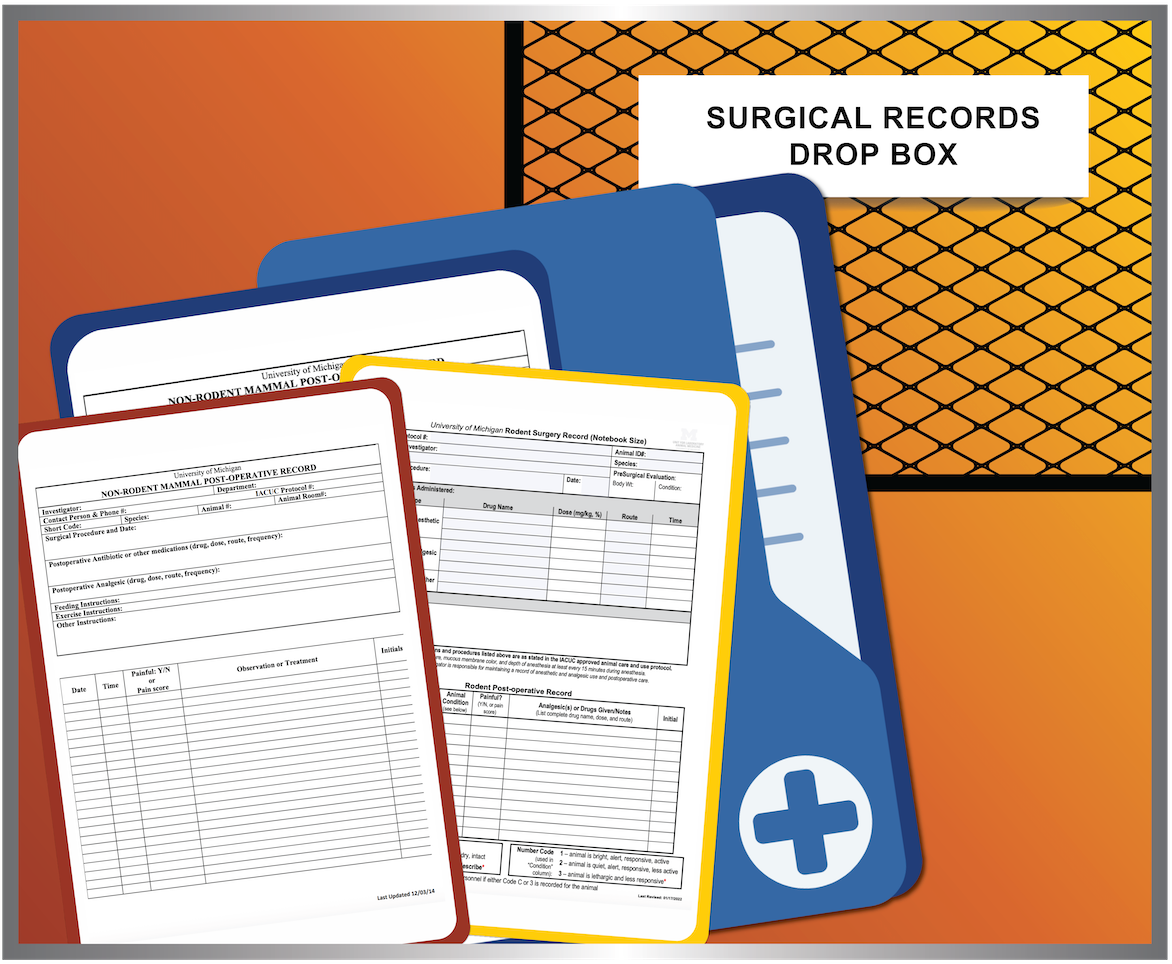
Accurate, appropriately managed and maintained animal health records are critical for documenting animal well-being and providing a complete history of surgical procedures, including any requisite post-operative care.
Records that are incomplete, incorrect, or improperly submitted may not only result in unnecessary treatment or diagnoses, but could also lead to research non-compliance.
To help members of the U-M research community navigate important recordkeeping requirements, the U-M Animal Care & Use Program has developed a new interactive tool  for animals undergoing anesthetic and/or surgical procedures.
The tool, accessible at animalcare.umich.edu/navigate-records using valid U-M login credentials, prompts users to answer three short multiple choice questions to determine WHAT information must be included in the record(s) and HOW the record(s) should be submitted to Unit for Laboratory Animal Medicine (ULAM) veterinary care staff.
After answering these questions, individuals will be provided with the recordkeeping requirements for their specific scenario. The tool can be used for many different species and procedure types, with an option to receive a curated list of references and resources via email.
Additional Recordkeeping Reminders
Any individual who is responsible for direct animal handling – especially post-operative care – is also encouraged to review the following recordkeeping guidelines:

- Variable data must be recorded in real-time as each observation is made. This includes:
- Date(s) of clinical observation(s) and/or monitoring
- Observation or monitoring entries (animal appearance, pain assessment, incision condition, tumor size, etc.)
- Treatment information (e.g., drug, dose, route, time given, etc.)
- Initials of each individual completing record entries
- Writing out the full name of all drugs used for anesthesia, analgesia, and research in the corresponding pre, intra, and post-operative records (e.g., Buprenorphine not “bup,” ketamine not “ket”). Include administered dose and route of administration
- Clearly identify which animals are described by each entry
- Write legibly
- Only the following static information may be pre-filled on a record:
- Lab name
- Protocol number(s)
- Cage number(s)
- Animal ID number(s)
Detailed instructions on how to generate, maintain, and store animal health records, including guidelines for specific record types (i.e., tumor monitoring, food and/or water restriction, post-operative care), can be found in the Guidelines on Medical Records for Investigative Personnel on the Research A-Z website.
Questions?
Questions or concerns about how to properly complete animal health records, including requirements for turning in records to ULAM veterinary care staff, should be directed to your ULAM Faculty Veterinarian.
General, non-urgent inquiries may also be sent to [email protected].
Thank you for your diligence and attention to safeguarding animal welfare and maintaining programmatic compliance through accurate recordkeeping practices.
Links marked with a lock icon can only be accessed using valid U-M login credentials.