
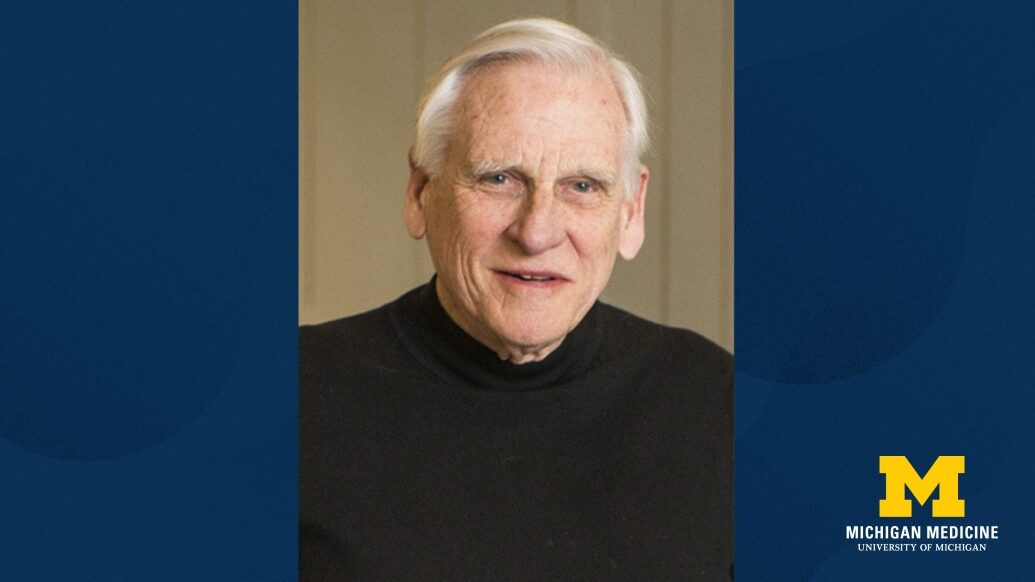
Robert H. Bartlett, M.D., an active emeritus surgeon at Michigan Medicine and professor at the University of Michigan (U-M) Medical School, died on October 20, 2025, after a long illness.
He was 86.
Bartlett was born where he spent much of his career, at University Hospital in Ann Arbor. He trained in general and thoracic surgery at what is now the Brigham and Women’s Hospital in Boston. During that time, he also learned research techniques in an academic surgery training program at Harvard Medical School.
Dr. Bartlett joined the faculty at the University of California, Irvine School of Medicine in 1970, then moved to the University of Michigan in 1980. While at UC Irvine, he continued research that others had begun in the 1960s, to develop extracorporeal membrane oxygenation (ECMO) technology for long-term heart and lung bypass to support failing organs.
The technology — first studied in sheep — involves a complex circuit that pumps blood from the body and oxygenates it outside of the body, to allow the heart and lungs to rest and recover from damage or disease. Much of Dr. Bartlett’s early focus was on developing the use of ECMO to treat newborns with underdeveloped or damaged hearts or lungs.
Throughout his more than 50-year career, Dr. Bartlett further refined ECMO technology to expand its use in more types of patients, explored the potential for artificial organs, and worked on ways to prolong the viability of transplantable organs. His leadership led to the creation of U-M’s Extracorporeal Life Support (ECLS) Lab, now directed by Alvaro Rojas-Pena, M.D.
“He guided generations of trainees and colleagues with wisdom, patience, and kindness, always leading by example and optimism. Beyond his remarkable achievements, it was his humanity that left the greatest mark — the way he listened, encouraged, and believed in others. He taught us not only how to be better professionals, but better people,” Rojas-Pena said.
Dr. Bartlett’s legacy lives on through the many people — including a considerable number of children — he helped save and the work that continues to advance science in service of future patients.
Read more about his extraordinary career by visiting the Michigan Medicine website.