Facilities Safety

EHS Implements New Repeat Deficiencies Process

In an effort to strengthen research and academic safety across the University of Michigan, beginning this month, laboratory inspection reports generated by the Department of Environment, Health and Safety (EHS) will now identify repeat deficiencies. A “repeat deficiency” is defined as a deficiency that is cited in two consecutive laboratory inspections. As EHS works diligently ...
Maize text on blue background: EHS Inspection Update on Repeat Deficiencies

Facilities Husbandry Safety SOP

Hazardous Substance Administration SOP Recently Updated

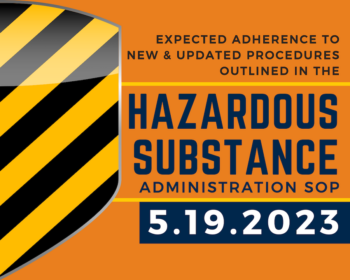
To ensure that all members of the U-M animal care and use community have the tools and resources necessary to comply with best practice standards in animal care and laboratory safety, the Animals Administered a Hazardous Substance Requiring Containment Standard Operating Procedure (SOP) has been updated. Key SOP changes are summarized below and will be highlighted on posters ...
Button listing expected May 2023 adherence date for new Hazardous Agents Administration SOP procedures

Facilities Husbandry Safety SOP ULAM

Handle With Care: Reminders for Safe Animal Transport

Transporting animals on campus (either from room to room, building to building, or through a public area) requires heightened attention to detail to ensure that animal health and welfare is maintained at all times. This includes, but is NOT limited to, preventing injury or escape, reducing environmental stressors (e.g., ambient temperature extremes, odors, and excessive ...
Handle with Care blue and green hands icon with yellow health shield

Drugs Facilities Guidelines Husbandry IACUC Policies Safety

Lessons Learned from Fall 2022 Semi-Annual Facility Inspections

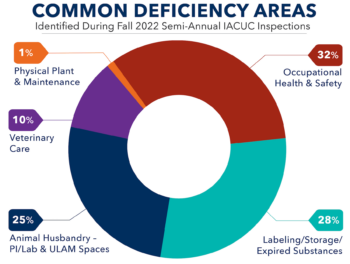
The Institutional Animal Care & Use Committee (IACUC) completed its latest round of semi-annual facility inspections in mid-September. These inspections are one of the most important tools we have for routinely assessing programmatic strengths and identifying areas for individual and collective improvement(s) in service to the animals entrusted to our care. Through this lens of ...
Multi-colored graph showing common deficiency areas identified during Fall 2022 semi-annual facility inspections

eRAM Safety

Review EHS Safety Findings to Protect Your Lab Personnel

Principal Investigators (or their proxies as assigned in eRAM) are required to identify any hazardous materials and operations that may be used as part of their animal use protocol. Based on the specific details (e.g., species, hazard type, dosage, route of administration) provided by the Study Team, the U-M Environment, Health & Safety (EHS) Department ...
Computer screen illustration with magnifying glass reviewing simulated EHS safety findings

Drugs Facilities Guidelines Husbandry IACUC Policies Safety

Lessons Learned from Winter 2022 Semi-Annual Facility Inspections

The Institutional Animal Care & Use Committee (IACUC) completed its latest round of semi-annual facility inspections in mid-March. These inspections are one of the most important tools we have for routinely assessing programmatic strengths and identifying areas for individual and collective improvement(s) in service to the animals entrusted to our care. Through this lens of ...
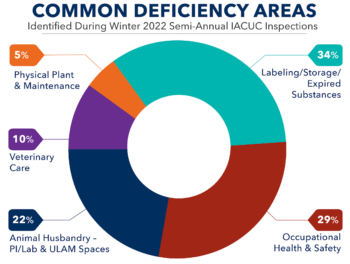
Multi-colored graph showing common deficiency areas identified during Winter 2022 semi-annual facility inspections

Facilities Safety

EHS to Resume Unscheduled Inspection Program

The unscheduled inspection program, led by the U-M Department of Environment, Health and Safety (EHS), was put on hold in 2020 due to the COVID-19 pandemic. With laboratory research activity returning to pre-pandemic levels, EHS has now resumed this program. What You Should Know Following each visit, Principal Investigators will receive a report that is ...
Inspection checklist on clipboard with PPE, food and drink, and chemical storage icons

Facilities Safety

Get Ready for Summer with Proper Personal Attire in the Lab

Wearing proper personal attire in the lab and animal care facilities protects both you and the animals entrusted to our care. With the warmer summer months ahead, we ask that you review the basics of proper personal attire in the lab with your staff, including all students who may be involved with research. REGARDLESS of ...
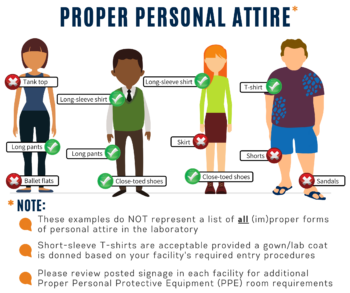
Infographic showing proper personal attire for the laboratory

Facilities Safety

Animal-Derived Substances and IBC Approval: Answering Questions About Swine and Ruminant Materials

Research that involves certain types of animal-derived substances – including materials from swine and ruminants – requires advance approval from the Institutional Biosafety Committee (IBC).  This requirement applies to research with tissues, fluids, and/or cells from: Expand each section below for answers to several frequently asked questions. The IBC requires Biosafety Level 2 (BSL2) precautions ...
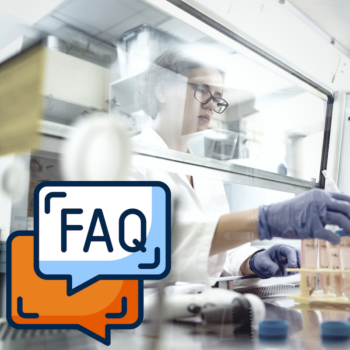
Image of woman working with samples under a biosafety cabinet hood. FAQ icon over top of image

Facilities Safety

Units Partner to Streamline, Strengthen Research Safety Processes

To continue strengthening laboratory and research safety across the University of Michigan, Environment, Health and Safety (EHS) is partnering with the U-M Research and Academic Safety Committee to develop and implement a new phase of its research safety initiative. The new phase of the initiative known as “Safety First, Safety Every Day” is launching in ...
Always wear the appropriate PPE. Research Safety First, Safety Every Day thumbnail badge icon