
Providing a safe, secure, and properly controlled research environment is critical for maintaining animal health and minimizing variables that could impact study results.
When moving animals across campus – either from room to room, building to building, or through a common area – extra care must be taken to protect animal welfare and the integrity of the animal’s surroundings.
All individuals who MAY transport animals are asked to review the Procedures for Animal Transportation to ensure that they are utilizing proper handling techniques to avoid exposure to potential pathogens, prevent injury, and reduce environmental stressors (e.g., temperature extremes, odors, excessive noise).
Proper handling techniques include, but are NOT limited to:
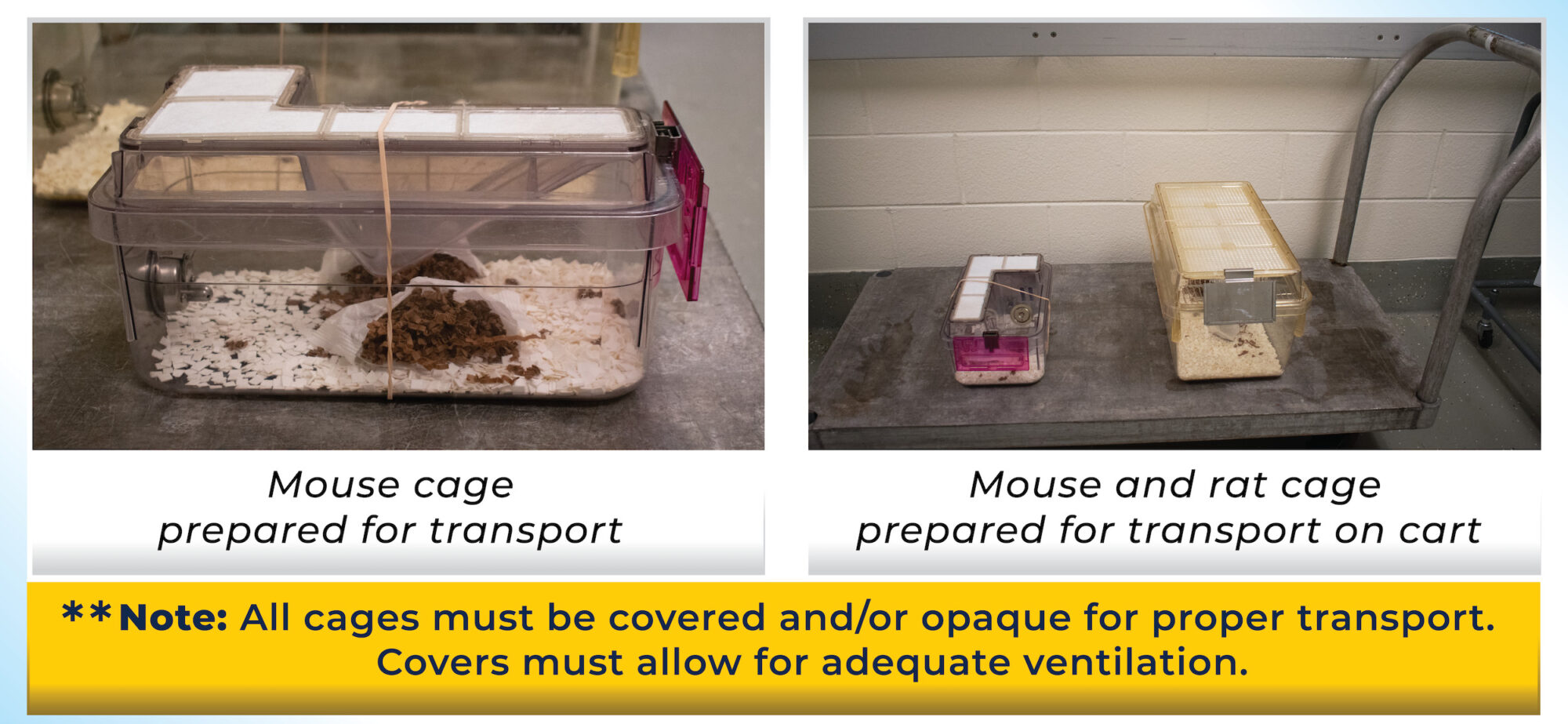
- Using primary enclosures that are –
- Secure and escape proof. Note: stretch rubber bands over the cage top and bottom for added security (see example by clicking to expand image at right)
- Maintained in a manner that minimizes the potential for physical injury/distress, especially on uneven surfaces which may lead to tipping or falling
- Made of material(s) that can be sanitized or disinfected to prevent cross-contamination**
- Covered and/or opaque, while still allowing for adequate ventilation
- Avoiding temperature extremes – below 40°F (4.4°C) or above 85°F (29.4°C)
- Conducting the transport in a timely manner
- Following a direct route that avoids common public areas wherever possible
- Using equipment (e.g., rolling carts or carriers) that is in good working order
**Separate procedures must be followed if transporting animals with experimental hazards. These procedures are summarized below and outlined in greater detail in the Animals Administered a Hazardous Substance Requiring Containment SOP.
Additional Considerations
IN ADDITION TO the techniques outlined above, transporting animals with experimental hazards outside the vivarium also requires the following:
- Placing animals in a clean housing cage (provided in each containment room)
- Labeling the cage with a dissolvable sticker indicating the type of hazard administered
- Wiping the outside of the cage with a suitable disinfectant
- Placing the housing cage in a rigid, sealed, secondary transport container that includes a sufficient amount of absorbent material to prevent movement. Note: secondary transport containers should be requested from ULAM
- Avoiding public passenger elevators, where possible
Complete step-by-step instructions, including information about transporting animals with experimental hazards within the vivarium, can be found in the Animals Administered a Hazardous Substance Requiring Containment SOP.
For larger and/or non-rodent species, or for specific circumstances not addressed by the SOP, please contact your facility’s ULAM Faculty Veterinarian or ULAM Husbandry Supervisor. 
The Unit for Laboratory Animal Medicine (ULAM) operates a temperature-controlled truck to help Study Teams move animals and equipment across campus.
With a minimum 48-hour (two business days) notice, ULAM Truck Services are available to:
- Transfer animals between buildings
- Deliver animals received at the ULAM Dock to other campus locations
- Pick up animals shipped to the Detroit Metro Airport
Transportation services can be arranged by emailing [email protected] or by calling (734) 936-2011 or (734) 936-6163.
Questions?
Additional questions about proper animal transportation procedures should be directed to your ULAM Faculty Veterinarian or ULAM Husbandry Supervisor.
Thank you for doing your part to safeguard the research environment for all members of the U-M community as well as the animals entrusted to our care.
Links marked with a lock icon can only be accessed using valid U-M login credentials.