
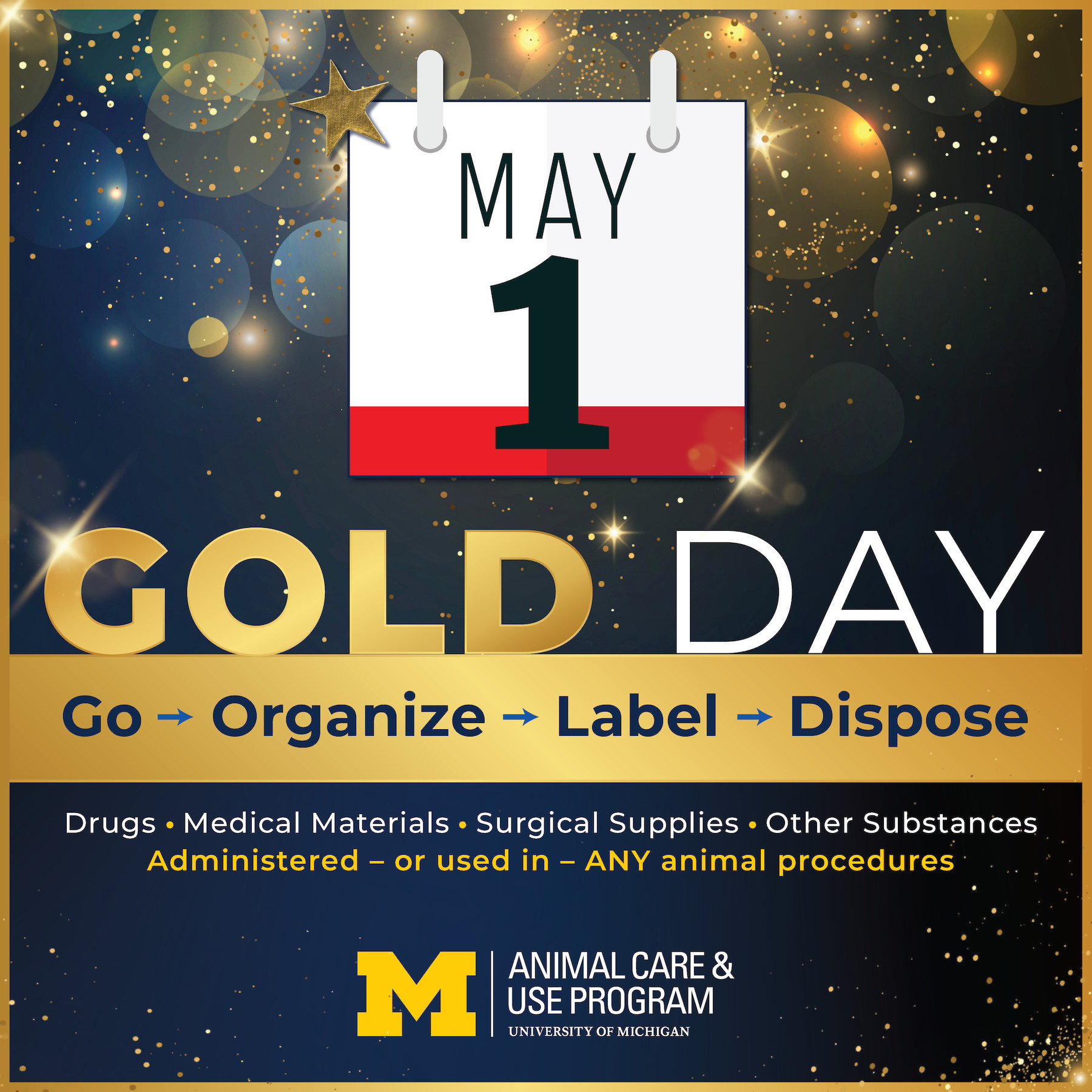
First launched by the Animal Care & Use (ACU) Program in 2023, this year’s GOLD Day will take place on Friday, May 1.
Now entering its fourth year, GOLD Day provides the U-M research community with a unique opportunity to set aside dedicated time to Go, Organize, Label, and Dispose of drugs, medical materials, surgical supplies, agents, and other substances administered – or used in – ANY animal procedure.
To help laboratories structure their GOLD Day activities, the ACU Program has partnered with several cross-campus units to curate the following list of resources pertaining to the proper storage, management, and use of drugs and other substances in animal-based research:
GOLD Day Resources
- All drugs, substances, agents (including biologics, fluids, vehicles, etc.), and other medical materials must be stored in accordance with:
- U-M requirements
- Manufacturer recommendations
- State of Michigan/DEA regulations (where applicable)
- Items must be clearly labeled as expired and separated from non-expired items until they can be appropriately discarded (see Dispose tab below).
- Consider creating and maintaining an internal schedule to regularly (e.g., monthly) review substance expiration dates.
- Assign an individual, or individuals, within the laboratory to routinely monitor, organize, and label substances. These individual(s) should also serve as the designated contact(s) for others who may have questions or concerns about related policies and procedures.
- Ensure that all potentially hazardous chemicals are entered into a Chemical Inventory. This inventory should be reviewed at least annually to minimize accumulation of unused or unwanted chemicals. Review the U-M Chemical Hygiene Plan on the Environment, Health & Safety (EHS) website for more information.
- To comply with Title 21, CFR.1301.72, laboratories using controlled substances in research must maintain additional security and storage controls.
Review the recently updated Quick Reference Sheet: Monitoring Expired Drugs & Medical Materials  for additional suggestions on developing a system to monitor for expired materials in your laboratory.
- Confirm that all substances and agents are clearly labeled with their full name, concentration, and the relevant Expiration or Beyond Use Date.
- Note: If the manufacturer recommendations include an Expiration and Beyond Use Date, the substance or agent expires on whichever date occurs first.
- If the manufacturer supplies a Beyond Use Date, download the standard program-provided Beyond Use Date Labeling Template. Each label contains space to write in the puncture date, beyond use date, and initials of the individual who punctured the vial.
- Expired items must be clearly labeled as expired and separated from non-expired items until they can be appropriately discarded (see Dispose tab below).
- Consider writing ‘No Exp’ on the packaging/bottle of any supplies that do NOT have an expiration date to easily identify these materials.
- Drugs and diluents should be placed into a sterile, rubber stoppered vial and labeled with the following information:
- Names of all drugs – written in full, without abbreviations – in the diluted mixture
- Concentration of drug mixture
- Preparation Date
- Expiration Date
- The expiration date for the diluted solution is determined by the earliest expiration date of any of its component drugs or diluents
- Names of all drugs – written in full, without abbreviations – in the diluted mixture
Detailed labeling and storage instructions are available in the Policy on the Use, Storage, and Expiration of Substances, Agents, and Medical Materials Used in Animals; the Guidelines on the Preparation of Injectable Substances and Agents Administered to Animals; and the Guidelines for the Storage of Sterile Items.
- Instructions on how to properly dispose of regulated waste – including chemical, radioactive, biological, and universal waste – are available on the EHS Hazardous Waste website.
- Call EHS Hazardous Materials Management at (734) 763-4568 or complete an online Waste Pickup Form to request waste pick up. Requests for waste disposal supplies should be submitted via the EHS Supplies Request Form.
- For information about properly disposing of select substances in sanitary drains, review the EHS Criteria to Dispose Substances in Sanitary Drains document.
- Visit the Controlled Substances Monitoring Program website for disposal steps and documentation requirements for disposing of controlled substances used in research.
- Information about sharps waste disposal can be found in the EHS Preparing Biohazardous Sharps Waste for Collection SOP.
- To donate or receive surplus chemicals, materials, and/or lab equipment, consider participating in U-M’s Lab Reuse Program. Note: Chemicals must be unexpired, in properly labeled containers, and able to be stored at room temperature. All other donation items must be functioning and in good condition.
Questions?
For Questions About…
Contact
Using specific drugs, agents, or other substances in animals
Your ULAM Faculty Veterinarian. If you don’t know your faculty veterinarian, send an inquiry to [email protected] and your question will be routed appropriately.
Establishing a system to monitor/manage drugs and medical materials in your laboratory
The Quality Assurance Team in the Animal Care & Use Office at [email protected]
Proper disposal of controlled substances
U-M’s Controlled Substance Monitors at (734) 764-2003 or [email protected]
Regulated waste pick up and/or supply request(s)
EHS Hazardous Materials Management at (734) 763-4568 or review the EHS Request Collection and Supplies webpage.
U-M’s Lab Reuse Program
Contact [email protected] or visit the Lab Reuse Program website.
Links marked with a lock icon can only be accessed using valid U-M login credentials.