Announcements

ULAM, ACUO Announce Winter 2025 Holiday Hours

Several service areas within the Animal Care & Use Program, including the Animal Care & Use Office (ACUO) and the Unit for Laboratory Animal Medicine (ULAM), will be closed or operating at limited capacity during the upcoming holiday season. Below is a list of operating schedules and plans for areas that may have a direct ...
winter scenery

eRAM Safety

EHS Medical Surveillance Questionnaire Moving to U-M Enterprise Health Portal

The university’s Animal Handler Occupational Health & Safety Program, co-administered by the Animal Care & Use Program and the Environment, Health & Safety (EHS) Department, not only protects personnel by ensuring safe research operations, it also plays a critical role in the U-M’s continued compliance with the federal Public Health Service Policy and accreditation by ...
Woman in medical scrubs works on laptop computer

ULAM

Lucy Kennedy Named Associate Director for Clinical Operations in ULAM

Lucy Kennedy, DVM, DACLAM, has been appointed to the role of Associate Director for Clinical Services in the Unit for Laboratory Animal Medicine (ULAM). The appointment was effective November 1, 2025. As Associate Director for Clinical Services, Dr. Kennedy will have managing oversight of veterinary clinical operations and quality assurance. She will also continue to ...
lucy kennedy headshot

QA

Have Compliance Questions? Get Answers with QA Virtual Office Hours!

The Quality Assurance (QA) Team in the Animal Care & Use Office offers virtual, on-demand office hours for the U-M research community to drop-in (via Zoom) and get help on a variety of topics, including protocol management, regulatory and compliance-related issues, inspection preparation, planning for the upcoming AAALAC 2026 Site Visit, and more. The QA ...
Image of young woman at computer with superimposed Quality Assurance Team text treatment

Drugs Facilities Guidelines Husbandry IACUC Policies Safety

Lessons Learned from Fall 2025 Semi-Annual Facility Inspections

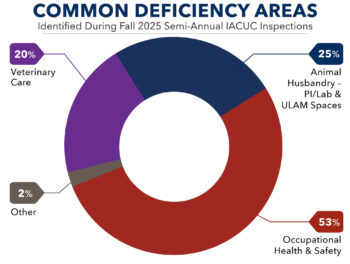
The Institutional Animal Care & Use Committee (IACUC) completed its latest round of semi-annual facility inspections in September. These routine inspections are one of the most important tools we have for assessing programmatic strengths and identifying areas for individual and collective improvement(s) in service to the animals entrusted to our care. Through this lens of ...
Multi-colored graph showing common deficiency areas identified during Fall 2025 semi-annual facility inspections

ULAM

Catch Up on Discussion Topics, FAQs from Fall 2025 ULAM Faculty Vet Check-In Meetings

To help keep the research community apprised of important updates and changes impacting animal care and use at the University of Michigan, ULAM Faculty Veterinarians hosted veterinary check-in meetings in Fall 2025. If you were unable to attend a meeting and would like to learn more about what was discussed, meeting resources are now available ...
PDF and FAQ document icon

Facilities Safety

New Research Safety Continuity Policy Introduced

To strengthen U-M’s culture of safety and enhance shared accountability in academic and research settings, the department of Environment, Health & Safety (EHS) and the Research and Academic Safety Committee have introduced a new Research Safety Continuity Policy. The policy, applicable to all faculty Principal Investigators (PIs) who manage a research laboratory, shop, and/or studio ...
Clipboard and person icons showing continuity plan for laboratory

Robert H. Bartlett, ‘Father of ECMO,’ Dies at 86

Robert H. Bartlett, M.D., an active emeritus surgeon at Michigan Medicine and professor at the University of Michigan (U-M) Medical School, died on October 20, 2025, after a long illness. He was 86. Bartlett was born where he spent much of his career, at University Hospital in Ann Arbor. He trained in general and thoracic ...
Robert Bartlett, M.D.

IACUC

ARRIVE Prepared: Essentials for Reproducibility and Incorporating the 3Rs

For more than 50 years, institutional and regulatory expectations have required appropriate justification for the use of animals in research, including consideration of all relevant new approach methodologies/non-animal models (NAMs), the “Three Rs” principle of biomedical research, and documentation on why a certain species/model is the most scientifically valid method of study. Detailed justifications are ...
Picture of technician holding white rat with 3Rs emblem